

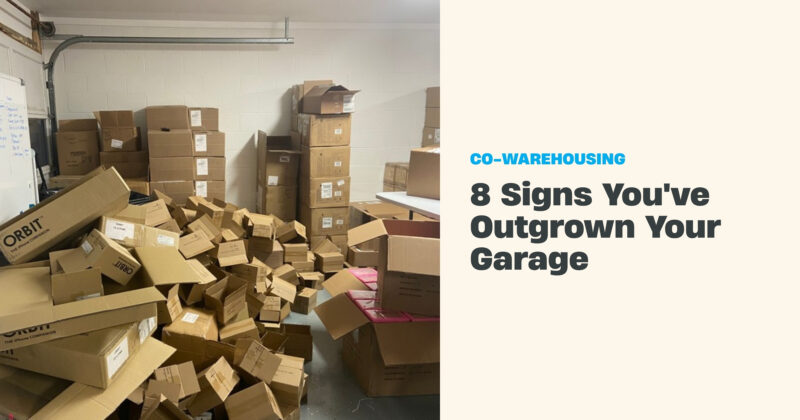
The short answer: Your product business has outgrown your garage when the space starts running the business instead of the other way around. The big signs: freight can’t get to you, you can’t buy in bulk, your shipping times are slipping, inventory has spread into the rest of the house, and you can’t bring on help. Most founders wait for a breaking point before they move. You don’t have to.
Nobody plans to run a warehouse out of their garage. It just sort of happens. One shelf becomes four. The car moves to the driveway. Then the driveway fills up too.
And because it happens a little at a time, it’s hard to see the moment you’ve outgrown it. Most founders don’t notice until something breaks: a missed shipping day, a ruined pallet, a family member who finally says, “We need to talk about the dining room.”
Here’s how to spot it sooner.
1. Freight can’t get to you
When your orders were small, the mail carrier was all you needed. Now suppliers ship by the pallet, and a pallet needs a truck, a liftgate, and somewhere flat to land.
Here in the mountains around Asheville, that’s a real problem. Plenty of our driveways are too steep or too narrow for a freight truck. If you’ve ever met a delivery in a store parking lot and hauled boxes home a few at a time (I have), you already know this sign.
2. The UPS driver knows your kids’ names
Daily post office runs. Carrier pickups you have to be home for. Dropping everything at 3:45 because the truck comes at 4.
None of it takes long on its own. Add it up across a week, though, and it’s hours that aren’t going into product, marketing, or sleep.
3. You’d buy in bulk, if you had somewhere to put it
Your supplier offers a better price at a bigger order. Your margins would thank you. Your garage says no.
This is one of the quietest ways a home setup caps growth. You keep paying more per unit because there’s nowhere to put the cheaper inventory.
4. Your shipping times are slipping
You used to ship in two days. Now it’s three, sometimes four, and customers are starting to notice.
This one stings, because it’s not about space at all. It’s about missing the standard you set for yourself. For a lot of founders, this is the breaking point that finally gets them moving.
5. Inventory has left the garage
It’s in the guest room. The hallway closet. Under the bed. Next to the Christmas decorations.
When the business spreads into every room, the house stops feeling like a home. And the people you live with notice before you do.
6. You need help, but there’s nowhere for them to work
You’re ready to bring on a packer, a part-timer, or even just a friend for launch week. But where do they go? Your kitchen? And where do you interview them?
One Ernest member was right at the point of needing to hire. Instead of adding a full-time person, they used our team for about two hours of packing help a day, just enough to get over the hump. Sometimes you don’t need a whole new hire. You need someone for half a day and a place to put them.
7. The packaging mess follows you everywhere
Packing at home doesn’t stay in the garage. I used to find crinkle-cut paper filler in my washing machine because it stuck to my clothes. And once a month, my husband loaded our minivan with broken-down boxes and drove them to the recycling center, 20 to 30 minutes each way, plus the time to load and unload.
None of that is a big deal on its own. Together, it’s a few more hours every month the business quietly takes from you (and your family). At Ernest, there’s a spot for flattened cardboard right in the building. If you know, you know.
8. It’s lonely
This one doesn’t show up on a spreadsheet. Running a product business from home means doing everything yourself, by yourself. No one to ask about a supplier, a shipping rate, or whether that new box size is worth it.
If you’ve started talking to the pallet jack you don’t own yet, it might be time.
“I’ll know when I’ve outgrown it”
Here’s the thing: most people don’t. The garage gets fuller so slowly that it starts to feel normal. Founders usually wait until a breaking point (family friction, missed shipping days, a disaster delivery) and then have to move in a hurry.
If two or three of the signs above made you wince, you’re probably already there.
What comes after the garage?
You’ve got a few options, and they fit different stages:
- Self-storage works for overflow you rarely touch. You can’t really work or ship from a storage unit, though, and there’s no loading dock.
- Co-warehousing gives you your own lockable space inside a shared warehouse, with the loading dock, forklift, carrier pickups, and community included. At Ernest, stations run from about 250 to 1,500 square feet, sized to how much space you actually need, and they’re month to month. (What is co-warehousing?)
- A warehouse lease makes sense once you have a team and steady volume, but it usually means a multi-year lease and buying your own equipment.
- Fulfillment (a 3PL) is for when you’re ready to hand off packing and shipping entirely.
Plenty of founders move through more than one. One Ernest brand started in a station, packing every order themselves. As they grew, packing was eating 40 to 50 hours a week, so they handed it to our fulfillment team without moving their inventory anywhere. Those hours went back into product, marketing, and design.
Ready to see what’s next?
Take our virtual tour from the couch (the one that used to be in your living room before the inventory moved in), or come by for a quick, zero-pressure visit. Fair warning: you might start measuring your garage on the drive home.
Frequently asked questions
How do I know if my business has outgrown my home?
Look for freight you can’t receive, bulk orders you can’t store, slipping shipping times, inventory in multiple rooms, and nowhere for help to work. Two or three of those usually means it’s time.
Can I run a product business from a storage unit?
Not easily. Most storage units have no loading dock, no power for packing stations, limited hours, and no carrier pickups. They work for overflow, not for daily operations.
What’s the next step after a home garage?
For most small product brands, it’s co-warehousing: private space in a shared warehouse with a dock and equipment, without a long lease. Brands that would rather hand off shipping entirely look at fulfillment.
How much space do I actually need?
Less than you’d think. Measure what you store today and add room for one or two bulk orders. Ernest stations run from about 250 to 1,500 square feet, and you can move up as you grow.
Do I have to sign a long lease?
Not at Ernest. Stations are month to month.