

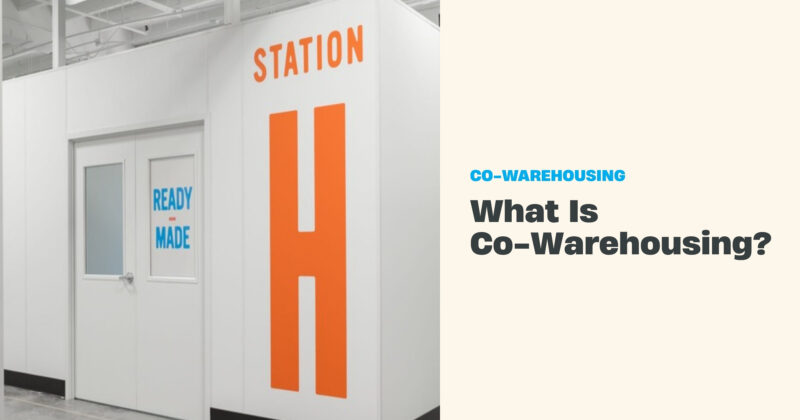
The short answer: Co-warehousing is a shared warehouse where small product businesses rent their own private, lockable space and share everything else: the loading dock, forklift, carrier pickups, packing areas, and the people. You get real warehouse infrastructure without signing a big lease or buying your own equipment. Think coworking, but for businesses with boxes.
There’s a moment most product founders know well. A semi truck is idling at the bottom of your driveway. The driver is looking at you. You are looking at your garage. Nobody is sure how this pallet is getting off that truck.
Here in the mountains around Asheville, the truck sometimes can’t even make it that far. Plenty of our roads and driveways are too steep or too narrow for freight. I used to meet delivery trucks in the Tractor Supply parking lot, break the pallets down by hand, and haul everything home in my minivan, a few boxes at a time. Not ideal.
If that sounds familiar (or if the UPS driver knows your kids’ names), you’ve probably already outgrown your setup. You just might not know what comes next, because the thing that comes next has a name most people have never heard: co-warehousing.
Let’s fix that.
What is co-warehousing?
Co-warehousing is a warehouse built for lots of small businesses at once. Each business gets its own private space, usually a lockable station or suite sized to its inventory. The expensive stuff that no small brand wants to buy alone is shared: a real loading dock, a forklift and pallet jacks, daily pickups from the big carriers, and room to pack.
It sits right in the gap between your garage and a warehouse of your own. Too much inventory for the house, not enough (yet) to justify leasing thousands of square feet and buying a forklift.
And like coworking, the people are part of the deal. Your neighbors are other founders figuring out the same things you are.
How does co-warehousing work?
Here’s what it looks like at Ernest, on Sweeten Creek Road in Asheville.
You pick a station based on how much space you actually need, anywhere from about 250 to 1,500 square feet. That’s about how much physical product you’re storing and packing, not how big your business is. A small, high-value line and a bulky one can be equally successful. They just take up different amounts of floor. And stations are month to month, so you’re never locked into a guess.
Then you move in. Your inventory lives in your station. You come and go 24/7. When a pallet shows up, it comes in through the dock instead of your driveway. When orders go out, they leave with the daily carrier pickups instead of in your back seat.
You still run your business your way. You still pack your own orders if you want to. The difference is that you’re doing it in a space built for it, with people around who can lend a hand (or a pallet jack).
What’s included in a co-warehousing space?
Every space is a little different, so it’s worth asking. At Ernest, a station comes with:
- A private, lockable station with dedicated power, hardline data, and wifi
- 24/7 access
- The loading dock, forklift, and pallet jack
- Daily carrier pickups and drop-offs
- A photo studio for product shots
- A breakroom, printing and copying, and free parking
- A building full of other product founders
Need extra hands for a big launch or a holiday rush? Members can add flex labor or pop-up space for short bursts, then scale back down.
Co-warehousing vs. self-storage vs. a warehouse lease
These get mixed up a lot. Here’s the quick version.
| Self-storage unit | Co-warehousing | Your own warehouse lease | |
|---|---|---|---|
| Loading dock and forklift | Rarely | Shared, included | You buy or rent your own |
| Can you work and pack there? | Not really | Yes | Yes |
| Carrier pickups | No | Daily | You set them up |
| Commitment | Month to month | Month to month | Multi-year lease, big minimums |
| Community | None | Built in | None |
| Best for | Overflow you rarely touch | Founders who want their own space and real infrastructure | Established brands with a team |
One honest note: you’ll also hear about 3PLs (third-party logistics companies), which store and ship your orders for you. Co-warehousing and a 3PL aren’t rivals. Plenty of brands start in a station, then hand off fulfillment once order volume makes packing a full-time job. (We wrote about the wins of switching to a 3PL if you’re curious.) At Ernest you can do both under one roof, so making that switch doesn’t mean moving your inventory across the country.
Who is co-warehousing for?
Usually a founder-led product business that has physically outgrown the house. Most people don’t plan the move. They hit a breaking point. Sometimes it’s personal: the dining room hasn’t been a dining room in a year, and someone at home has started saying so. Sometimes it’s the business: you’ve always shipped in two days, now you’re running behind, and customers are noticing.
Other signs it’s time:
- You’re receiving pallets you have no good way to unload
- You’d buy in bulk to save money, if only you had somewhere to put it
- Inventory has taken over more than one room
- You’d like to hire help, but you can’t exactly interview people in your garage
- You’re tired of doing all of this alone
If two or three of those made you wince, it’s worth a look.
What does staying home actually cost?
Co-warehousing is priced by how much space you need, month to month. But the number most founders never add up is what it costs to keep running things from home. It doesn’t show up on an invoice, so it’s easy to miss:
- Time. Post office runs, meeting freight in parking lots, and unloading by hand. Hours every week that aren’t going into product or sales.
- Money. Bulk discounts you can’t take because there’s nowhere to put the inventory. Damaged boxes from too many trips.
- Space. The garage, the guest room, the dining table. Rooms you’d like back.
- Growth. Help you can’t hire because there’s nowhere for them to work, and shipping times that slip during busy weeks.
- Headspace. Running a real business alone, in the same place you’re supposed to relax.
Add those up honestly and “staying home to save money” often isn’t saving much.
What it looks like in real life
East Perry imports sheepskin products from Eastern Europe. Before Ernest, that meant trying to coax semi trucks up a home driveway and stacking skids of inventory in the garage.
Moving into a station changed more than the address. With a real dock and room to store more, she could buy inventory in bulk and support more of the small farmers she sources from. That’s the part we love: the space is just the start. What people do with it is the good stuff.
Is co-warehousing right for you?
If your product business is bursting out of the house and you’re not ready (or don’t want) to lease a warehouse of your own, co-warehousing is probably the next chapter.
The easiest way to know is to see it. Poke around our virtual tour from your couch, or come down for a quick, zero-pressure visit. Fair warning: you might start measuring your garage on the drive home.
Frequently asked questions
What’s the difference between co-warehousing and coworking?
Coworking is shared office space for people who work on laptops. Co-warehousing is shared warehouse space for businesses that store and ship physical products. Ernest has both under one roof.
Is co-warehousing the same as self-storage?
No. Self-storage is a place to keep things. Co-warehousing is a place to run a business: you can receive pallets at a loading dock, pack orders, ship with daily carrier pickups, and work alongside other founders.
Can I get help packing orders?
Yes. Ernest members can add flex labor for busy stretches, and if you’re ready to hand off shipping completely, our fulfillment team can take it over without your inventory ever leaving the building.
Can I move to a bigger space as I grow?
Yes. Stations come in several sizes, and members move up as their inventory grows.
Who can use co-warehousing at Ernest?
Co-warehousing is for product businesses in and around Asheville and Western North Carolina. Our fulfillment and trade show services work with brands nationwide.
Do I have to sign a long-term lease?
No. Stations at Ernest are month to month, so you can start with what you need now and change sizes as you grow.